

The best crappie lures are small, live-like, and move naturally through the water to perfectly mimic the minnows and insects crappie naturally target.
Our top pick is the Bobby Garland Slab Slay’R on a 1/16 oz jighead in chartreuse or white. It catches crappie in more conditions than any other single lure we’ve tested. If you only buy one thing, buy that.
Crappies are clever and selective feeders. Which is why catching them consistently requires more than just any lure.
These feed on opportunities and are also finicky. You have to match the lure profile, color, and fall rate to water conditions. The lures that consistently produce across seasons nail all three.
This guide covers the best lures for crappie by season, type, and size, helping you catch more fish.
We break down specific product recommendations with honest pros and cons, explain which crappie lure colors actually matter (and which are just marketing), and settle the jigs vs. minnows debate with real on-the-water data. Whether you are fishing from the bank or a boat, this is what works.
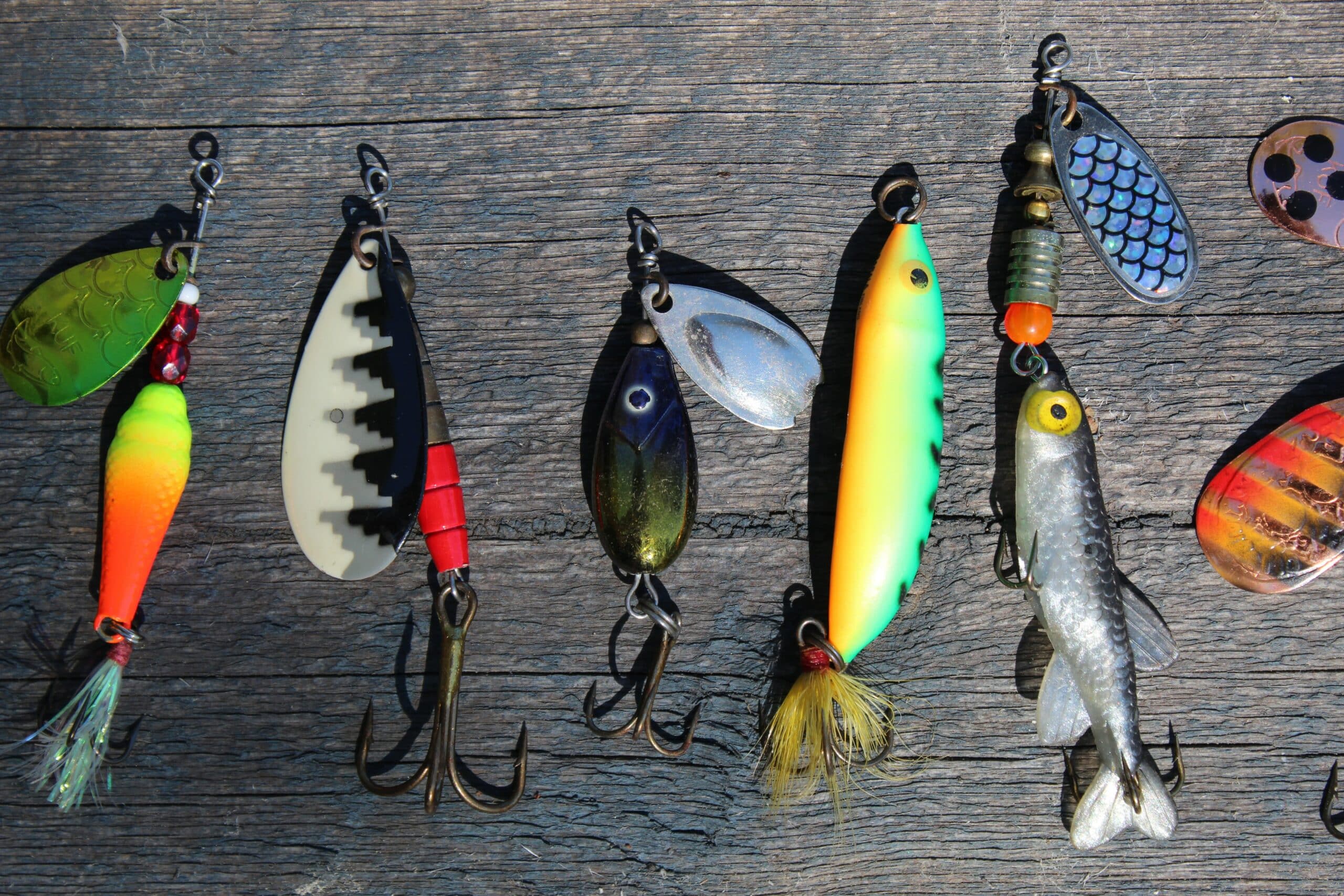
Quick Comparison: Best Crappie Lures by Type
| Lure | Type | Best For | Works In | Price Range |
|---|---|---|---|---|
| Bobby Garland Slab Slay’R | Soft plastic (spear tail) | All-around crappie, under floats, vertical jigging | All seasons, especially spring and summer | ~$4/pack of 10 |
| Z-Man Shad FryZ | Micro swimbait (paddle tail) | Pressured fish, multi-species, durability | Clear water, slow retrieves | ~$5/pack of 8 |
| Blakemore Road Runner | Spinner jig (marabou or grub) | Aggressive fish, stained water, pre-spawn | Spring, fall, windy conditions | ~$5-8/card |
| Dovesun Marabou Jigs | Hand-tied marabou | Budget-friendly variety, ice fishing, cold water | Fall, winter, finicky fish | ~$10-15/40-pack |
| Southern Pro Lit’l Hustler Tube Kit | Tube jigs (complete kit) | Beginners, panfish, shallow cover | Spring, vertical jigging | ~$15/kit |
What Makes The Best Crappie Lures?
The best crappie lures constantly produce because they align with the way crappie naturally feed. After doing on-the-water testing across pressured lakes and varying water clarity, we found the factors that matter the most. These are the correct size, subtle action, and reliable color visibility. When three of them come together, crappie lures trigger more strikes irrespective of season.
Subtlety Triggers More Bites
Crappie prefer lures that move naturally. Based on our experience, baits that glide or quiver outshine those that dart aggressively. This is especially true when you use crappie jigs, where soft materials create lifelike movement even at slow speeds. Forum anglers on Crappie.com consistently confirm this: the slowest presentations outfish aggressive retrieves, particularly on pressured lakes.
Size and Fall Rate Are Important
In pressured waters, smaller profiles generate more consistent bites. A slow, controlled fall rate keeps crappie fishing lures in the strike zone longer. This gives fish time to commit. Most crappie won’t chase a fast-falling lure. They watch it, decide, and strike from below. If your jig drops through the strike zone in two seconds, most fish never get the chance.
Go For Color Visibility
Don’t fall for brand hype. Go for colorful crappie lures to remain visible in changing light conditions. Whether you are fishing with the best crappie jigs, plastics, or spinners, a few proven colors will cover 90% of situations. Chartreuse for stained water, white for clear water, and a natural translucent for pressured fish. The crappie will always tell you what they want.
Best Crappie Lures: Detailed Reviews
1. Bobby Garland Slab Slay’R, Bluegrass (Best All-Around Soft Plastic)

You can rig the Bobby Garland Slab Slayer on a light crappie jighead. Its solid body holds firmly while the thin spear tail creates a lifelike wavering action. It glides on the fall and darts when twitched. It’s great under a float if you know the depth crappie are striking at, since they feed upward.
The black/chartreuse silver combination gets mentioned repeatedly on Ohio Game Fishing forums as a year-round workhorse. One angler reported using the Slab Slay’R 75% of the time across an entire season. But the soft plastic may tear after repeated strikes, so budget 2 to 3 bodies per trip on busy days.
Pros:
- Spear tail action triggers strikes even from lethargic crappie
- Holds position on jigheads better than most soft plastics
- Available in a wide range of proven colors (Bluegrass, BBQ Chicken, Keystone Candy are fan favorites)
- Works under floats, on slow retrieves, and for vertical jigging
- Affordable at roughly $4 per pack of 10
Cons:
- Soft plastic tears after a handful of fish. Budget 2 to 3 bodies per trip.
- Tail can stick to the jig hook if rigged with the open side facing the hook
- Not as durable as tube jigs or ElaZtech plastics
- Primarily targets crappie. Not as versatile across species as the Z-Man Shad FryZ.
Best for: All-around crappie fishing, tournament anglers who need consistent action, anglers fishing under floats at known depths.
Skip if: You want maximum durability per bait, or you’re fishing multi-species and want one plastic that catches everything.
2. Z-Man Shad FryZ Micro Swimbait (Best for Pressured Fish and Durability)
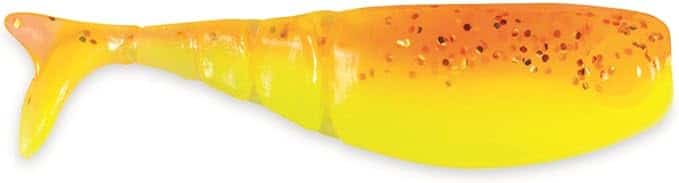
The Z-Man Shad FryZ micro swimbait is designed to copy shad and panfish fry. Its Tough ElaZtech body delivers extreme durability and lifelike swimming action. People say it’s the toughest bait they have ever fished. Even those darn blue gills can’t tear this bait up. One angler on Discount Tackle reported catching over 50 crappie on a single bait during the spring spawn without replacing it.
The tradeoff is price. At roughly $5 for 8 baits, you’re paying 60 cents per bait compared to 40 cents for Bobby Garland. But when each bait lasts 10 to 20 times longer, the math favors the Z-Man over a full season.
Pros:
- ElaZtech body is virtually indestructible. Highest fish-per-bait ratio of any crappie plastic.
- Realistic shad profile with subtle paddle tail action at slow speeds
- Catches crappie, bass, bluegill, perch, walleye, and more. True multi-species bait.
- Special hookslot makes rigging on Micro ShroomZ jigheads fast and straight
- Swimming action on the fall triggers strikes from neutral fish
Cons:
- Pricier per pack than Bobby Garland and Southern Pro options ($5 for 8 vs. $4 for 10)
- ElaZtech material doesn’t hold scent or accept adhesives well
- Requires light tackle for best performance (1/16 oz or lighter jigheads)
- Tail durability, while good, isn’t quite as long-lasting as other Z-Man products according to some Crappie.com users
- Limited to 10 color options compared to Bobby Garland’s extensive lineup
Best for: Pressured lakes where finicky crappie need ultra-realistic presentations. Multi-species outings. Anglers tired of replacing plastics every few fish.
Skip if: You rely heavily on scented baits. You need a huge color selection to match hyper-specific forage patterns.
3. Blakemore Road Runner Bulk Head Hook (Best Spinner for Stained Water)
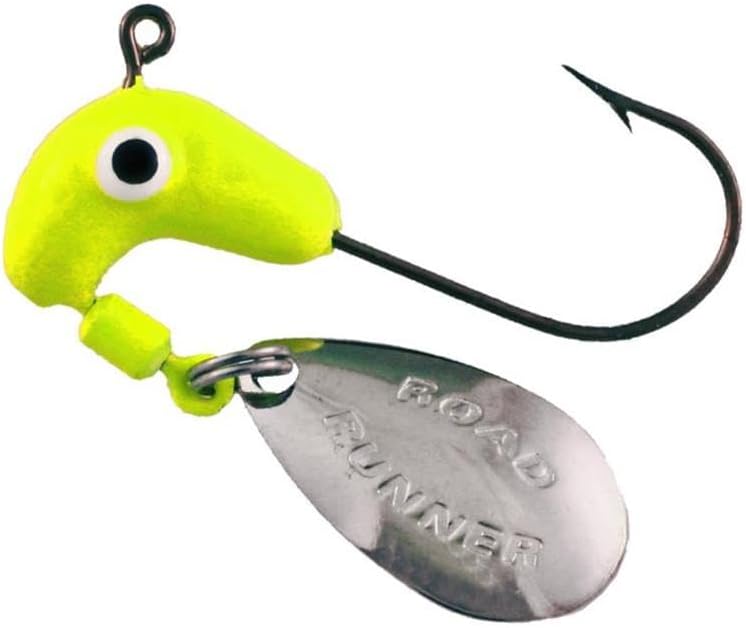
The Road Runner’s small blade adds flash without spoiling the presentation, making it the best option in stained water or windy conditions. It’s been catching crappie for over six decades. Forum anglers on Crappie.com consistently report solid chartreuse and solid pink as the most productive colors.
The inventor’s advice still holds: you can’t fish a Road Runner wrong as long as you fish it slow. Available in marabou, curly tail, and bubble belly body styles with Colorado and willow blades in sizes from 1/32 to 1 ounce.
Pros:
- The spinner blade adds flash and vibration that calls crappie in from a distance in low-visibility water
- Available in marabou, curly tail, bubble belly, and other body styles for different conditions
- Comes in 1/32, 1/16, 1/8, and 1/4 oz sizes covering shallow to deep presentations
- Versatile: cast, troll, vertical jig, fish under ice. It works every way.
- Proven track record spanning 60+ years
Cons:
- The non-barbed hook reduces holding power. Fish shake free more easily on slack line.
- The spinner blade can spook neutral or pressured crappie. Not ideal for clear, calm conditions.
- Marabou bodies can’t be swapped as easily as soft plastic, so color changes require retying
- Priced higher per unit than plain jig heads with soft plastics
- Reports of brittle hooks on some production runs
Best for: Pre-spawn and fall fishing when crappie are actively feeding. Stained water. Windy days when you need vibration to help fish locate the lure. Anglers who troll or cast and retrieve.
Skip if: You’re fishing ultra-clear, pressured lakes where subtle presentations outperform flash. Dead-stick or dock-shooting situations.
4. Dovesun Crappie Jigs (Best Budget Marabou Kit)
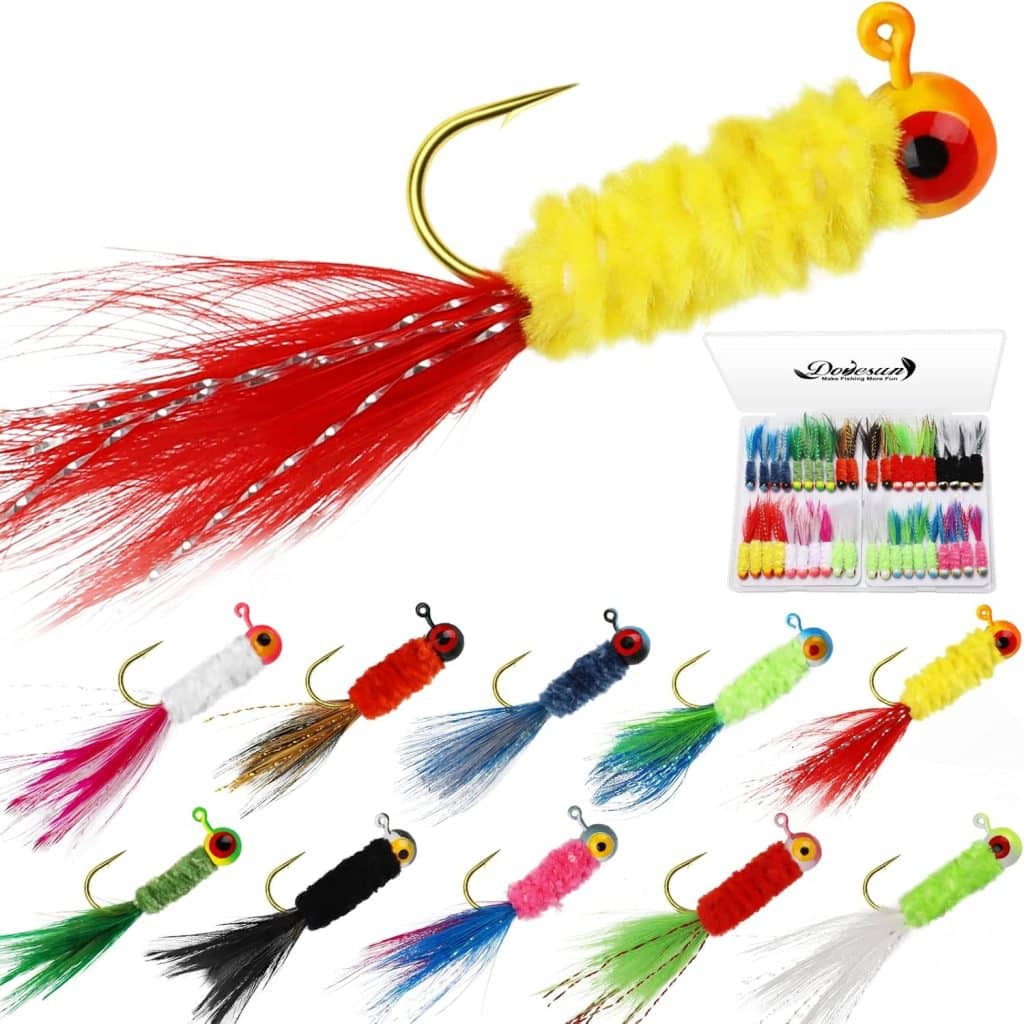
These are hand-tied marabou feathers with chenille bodies and bright two-tone painted heads. For roughly $10 to $15, you get 40 jigs in 10 colors with three weight options (1/32, 1/16, and 1/8 oz), all organized in a slim plastic case. At 25 to 35 cents per jig, they cost a fraction of name-brand marabou jigs.
But the paint chips over time and the hooks are light wire. You’re not getting Bobby Garland or Road Runner quality, but you are getting 40 functional jigs for the price of one premium lure card.
Pros:
- Exceptional value at 25 to 35 cents per jig. 40 jigs in a neat, organized case.
- 10 color options let you test what works in your local waters
- Available in 1/32, 1/16, and 1/8 oz covering shallow to deep presentations
- Marabou action is genuine and effective, especially in cold water
- Compact storage case fits in any tackle bag
Cons:
- Light wire hooks bend easily on anything bigger than crappie
- Head paint chips after a handful of uses
- Quality control is inconsistent. Some jigs are tied better than others in the same pack.
- Not a substitute for premium marabou jigs in tournament or high-pressure situations
- No established track record like Bobby Garland or Blakemore
Best for: Budget-conscious anglers, beginners building a first crappie tackle box, ice fishing, and testing new colors without spending $5 per pack.
Skip if: You’re fishing tournaments where lure quality directly impacts results. You target larger species beyond panfish.
5. Southern Pro Lit’l Hustler Tube Kit (Best Starter Kit for Beginners)
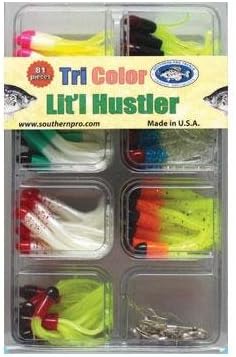
The Southern Pro Lit’l Hustler Tube Kit provides a complete crappie setup with seventeen proven tube colors and minnow head jigs in an eighteen-compartment reusable box. One Crappie.com angler below a dam caught 11 crappie on red and white Southern Pro tubes while everyone else was catching yellow bass.
However, the tube size targets mainly panfish. Perfect for average crappie but won’t attract the slabs that larger presentations pull. Think of this as your foundational kit, not your only kit.
Pros:
- Complete setup with seventeen colors and matching jig heads in one organized box
- Removes the guesswork for beginners wondering what to buy
- Tube jig design is proven across decades of crappie fishing
- Reusable tackle box keeps everything sorted and accessible
- Affordable for the amount of variety included
Cons:
- Tube sizes target smaller panfish. Won’t consistently attract trophy crappie.
- Prop 65 lead warning on packaging (standard for lead jig heads, but worth noting)
- Not as versatile as soft plastics for different rigging methods
- Jig head quality is adequate but not premium
- Tubes are less durable than solid-body plastics like the Bobby Garland Slab Slay’R
Best for: First-time crappie anglers who want a complete, ready-to-fish setup. Panfish outings with kids. Testing tube colors in your local waters.
Skip if: You’re an experienced angler who already knows which colors and styles work in your area.
What Are Crappie Jigs?
When anglers ask about the best lures for crappie, jigs are the most reliable option. These are artificial lures that consist of a weighted jig head, a small hook, and soft plastic, feathery, or hairy body. They are designed to imitate insects, shad, or minnows, allowing anglers to control depth precisely.
Tube, marabou, and paddle tail are the common types of crappie jigs. Marabou is the soft, downy feathers from a chicken, which, when submerged, create a flowing action that is more lifelike than any other material. When fish won’t chase, its subtlety is usually the only thing that works. Forum anglers and tournament pros alike consistently rank marabou jigs as the top choice for cold water and finicky fish because the feathers pulsate with even the slightest movement or current.
What Are Crappie Baits?
Crappie baits are artificial or natural offerings designed to attract and catch crappie. Jigs, including marabou jigs, soft plastic minnows, and small crankbaits, dominate the artificial crappie baits category for modern crappie fishing.
Anglers use these to lure crappies, especially the Bobby Garland crappie baits. This gives you more fish because their plastics hold the scent and naturally move slowly. The soft plastics are easy to pair with different jig heads and are effective for both casting and vertical fishing.
When to Use Crappie Spinners and Crankbaits?
Yes, jigs lead, but during active feeding, crappie spinners and crappie crankbaits shine. When fish are aggressive and chasing, we use spinners in shallow water.
Use the Road Runner lure crappie. Its small blade adds flash without spoiling the presentation, making this the best in stained water or windy conditions. The spinner blade helps crappie locate the lure when visibility is low. Pre-spawn and fall are the two seasons where spinners consistently outperform plain jigs because fish are moving aggressively and responding to reaction baits.
Crankbaits work best in summer when crappie spreads out. A small crankbait trolled through suspended schools covers ground faster than any jig presentation. Keep the profile small (under 2 inches) and fish them with erratic pauses. Crappie strike crankbaits on the pause, not during the steady retrieve.
What Are the Best Crappie Lure Colors?
The best crappie lure colors depend on light penetration, water clarity, and fishing pressure. Through multi-season testing in clear lakes, heavily pressured, and stained reservoirs, we found a few colors consistently perform better. Therefore, choose the right color to help crappie locate your lure faster.
Chartreuse for Stained Water
When visibility is limited, a chartreuse crappie lure is one of the most reliable options. Chartreuse holds its color and remains visible in low-light conditions. This one is perfect for stained water, early mornings, and cloudy days. Crappie.com forum anglers overwhelmingly name chartreuse (often in combination with another color) as their number one producer. Blue/chartreuse, black/chartreuse, and red/chartreuse combinations dominate the favorite color discussions.
White for Clear Water Conditions
A white crappie jig gives the best fishing experience in clear water and bright sunlight. White closely copies natural forage like minnows and shad, making it anglers’ favorite when crappie are selectively feeding. Michigan Sportsman forum members report milky white as one of their top trolling colors, with some reporting 200 to 300 fish days on white and natural patterns.
Natural Tones for Pressured Fish
Translucent tones and natural shad produce more bites in highly pressured lakes. Motor oil, green pumpkin, and pearl are consistent producers in this category. We keep rotating colors until the fish responds. Plus, crappies will always tell you what they want.
What Size Jig Head For Crappie?
The right jighead size for crappies is between 1/32 oz and 1/8 oz. It’s critical because jig weight directly affects depth control, fall rate, and how your presentation looks in the water. In our testing, even in the presence of fish, selecting the wrong size often leads to fewer bites. Therefore, the anglers’ debate around 1/16 oz vs 1/32 oz jig head comes down to conditions and crappie behavior.
How Jig Head Size Affects Bites
Crappie is sensitive to how fast a lure falls. This means a quickly dropping jig moves through the strike zone before the fish commits. At the same time, a slower fall often leads to reaction bites.
How To Choose Jig Head Size
The right jig head size immediately improves presentation and bite size frequency. So, we choose based on real-world conditions:
| Jig Head Size | Best Conditions | Fall Rate | When to Use |
|---|---|---|---|
| 1/32 oz | Shallow water, cold fronts, calm conditions | Very slow | Finicky fish, ice fishing, shooting docks |
| 1/16 oz | All-around, everyday fishing | Moderate | The default choice for most situations |
| 1/8 oz | Deep water, strong wind, heavy current | Fast | Maintaining vertical control, reaching suspended fish |
The 1/16 oz jighead is the starting point for 80% of crappie fishing situations. Move to 1/32 oz when fish are shallow and finicky. Move to 1/8 oz when you need to punch through wind or reach fish at 15 feet or deeper.
Jigs versus Minnows: When to Use Each?
Anglers ask when they should use jigs versus minnows. Your answer depends on conditions, efficiency, and fish behavior. We regularly fish both, but each option shines in particular situations. It’s recommended to understand when to switch, as that increases your catch rate.
In most scenarios, jigs are our favorite. They allow you to efficiently cover water. When targeting active fish, exploring new areas, or fishing from the bank, we rely on jigs. Artificial presentations also offer better control over depth and fall rate. This helps keep crappie fishing lures in the strike zone for a long time.
Whereas, minnows perform well when water temperatures drop sharply, or the fish itself becomes lethargic. When artificial struggle in extremely cold conditions or heavily pressured lakes, live bait triggers bites that plastics can’t replicate.
The compromise that works: Tip a 1/16 oz marabou jig with a lip-hooked minnow. You get the depth control and versatility of a jig with the scent and movement of live bait. Forum anglers on Crappie.com frequently mention this combination as their cold-water go-to. Some anglers substitute Crappie Nibbles or a piece of nightcrawler for a similar effect without the hassle of keeping bait alive.
In short, artificial crappie fishing lures simply excel live bait in most situations because they let anglers adapt faster.
What Are Best Crappie Lures By Season?
Selecting the right presentation heavily depends on seasonal crappie behavior. Understanding crappie’s movement and feed throughout the year helps narrow down the most effective crappie lures.
For Spring
Crappie lures for spring should be small and fished shallow. We rely on light jigs and soft plastics pitched around brushes, docks, and laydowns. Bright colored lures are used because runoff usually decreases water clarity. The Bobby Garland Slab Slay’R in bright patterns pitched under a float is a consistent spring producer, and the Blakemore Road Runner excels during pre-spawn because crappie respond well to the flash and vibration of the spinner blade.
For Summer
As water temperature rises, crappie lures for summer must reach suspended fish. Mid-depth crappie spinners, jigs, and small crappie crankbaits excel when fish move offshore. The Dovesun Marabou Jigs in 1/8 oz are useful here for reaching deeper structure quickly, and the Bobby Garland Slab Slay’R on a Road Runner head works well for casting along structure contours.
For Fall
During autumn, crappie lures for fall should closely copy baitfish. Silver, white soft plastics, and compact crankbaits shine as crappie feed aggressively. The Blakemore Road Runner with a curly tail grub is particularly effective during the fall feed because the spinner blade mimics wounded baitfish, triggering reaction strikes from aggressive fish.
For Winter/Ice Fishing
In cold conditions, crappie lures for winter/ice fishing need subtle action. Tiny plastics and Marabou jigs fished vertically trigger bites when fish are inactive. Drop your jig into the strike zone and let it sit. Twitch it gently every 10 to 15 seconds. The Dovesun Marabou Jigs in 1/32 oz are ideal for this slow, patient presentation, and their affordable price means you won’t stress about losing a few to snags in deep brush.
Frequently Asked Questions
What is the single best crappie lure for beginners?
A 1/16 oz marabou jig in white or chartreuse. It’s the simplest lure to fish, it works in all seasons, and it catches crappie consistently without requiring any special technique. Cast it near structure, let it sink slowly, and retrieve with gentle twitches.
Do crappie lure colors really matter?
Yes, but not in the way the lure companies want you to think. You don’t need 30 colors. You need chartreuse for stained water, white for clear water, and a natural translucent pattern for pressured fish. Those three cover roughly 90% of situations.
What’s the difference between 1/16 oz and 1/32 oz jig heads?
The 1/16 oz falls faster and works better in moderate depth, wind, and current. The 1/32 oz falls much slower and excels in shallow water, calm conditions, and cold fronts when fish are finicky. The practical difference: a 1/32 oz jig keeps your lure in a 4-foot strike zone roughly twice as long as a 1/16 oz jig.
Can I use crappie lures for other species?
Absolutely. Most crappie lures catch bluegill, perch, white bass, and even largemouth bass. The Z-Man Shad FryZ is particularly effective as a multi-species bait, with anglers reporting catches of crappie, bass, bluegill, shellcracker, sauger, walleye, and catfish all on the same lure.
Are expensive crappie lures worth it?
Sometimes. Premium lures like the Z-Man Shad FryZ cost more per pack but last significantly longer per bait. Budget options like the Dovesun Marabou Jigs cost less upfront but may have inconsistent quality. For casual fishing, budget jigs are perfectly fine. For tournament fishing or full-day outings, invest in Bobby Garland or Z-Man.
Should I use a float with crappie jigs?
Yes, in most situations. A slip float lets you hold your jig at the exact depth crappie are feeding, and since crappie strike from below, precise depth control is critical. Set the float 6 to 12 inches above the depth you’re marking fish.
What’s the best crappie lure for stained or muddy water?
A chartreuse crappie jig or a Blakemore Road Runner with a chartreuse grub body. Chartreuse maintains visibility in low-light and stained conditions better than any other color. The Road Runner’s spinner blade adds vibration that helps crappie locate the lure when they can’t see it clearly.
How do I know when to switch lure colors?
If you’re not getting bites after 15 to 20 casts in an area where you know fish are present, change colors. Start with chartreuse in dirty water or white in clear water. If neither works, try a natural translucent pattern. The crappie are telling you something. Listen.
Final Thoughts
The best lures for crappies aren’t difficult to find. Focus on size, fall rate, and colors. Collect a mixture of crappie jigs, spinners, soft plastics, and a few crankbaits to be ready for any condition.
Start with a 1/16 oz jighead and a Bobby Garland Slab Slay’R in chartreuse and white. Add a pack of Z-Man Shad FryZ for durability and multi-species versatility. Throw in a few Blakemore Road Runners for stained water and windy days. And if you want a budget kit to fill gaps or test new colors, grab a Dovesun 40-pack.
Match your approach to season and water clarity, and you will catch more fish with proven crappie lures.
